6-Day Budget Kilimanjaro Machame Route

From $3011
/ Adult
  • Unbeatable Value Assurance - ( Discover extraordinary adventures )
  • Effortless Reservation Process - ( No booking hassles )
  • Transparent Pricing, Zero Surprises - ( No hidden costs )
  • Expertise Beyond Measure - ( Team of seasoned experts )
  • Your Joy, Our Priority - ( Happiness Commitment )

Overview

Machame Route, starting at 1,640m, winds through diverse landscapes, showcasing giant lobelia and Senecio. The highlights include the Lava Tower ascent, Barranco Wall climb, and Karanga Valley trek. Day 5 features a midnight summit attempt at Uhuru Peak, followed by a descent to Barafu Camp. Day 6 descends to Mweka Gate, ensuring gradual acclimatization amidst Kilimanjaro’s beauty. Climbing demands both physical and mental readiness, emphasizing the need for a reputable tour operator.

Day By Day

Morning departure from Arusha to Lake Manyara National Park.

After breakfast, you will be collected from your lodge and taken to the Kilimanjaro National Park. While your guide is registering, you can watch the mountain team preparing – it is always impressive ‘what’ and particularly ‘how’ everything is carried up the mountain. Once this is all packed up, your adventure will begin; after a few minutes you will be deep within the forest with ancient trees, ferns, mosses and black and white colobus monkeys frolicking in the treetops. After 5 – 6 hours you will reach – Machame Camp –situated just above the forest line at 3000 m. Arriving here, the porters have already set up your tents and warm water for washing is ready.

Lunch, Dinner
Public Campsite

After an early morning start, the path steepens and the vegetation changes into a moorland with shrubs such as hardy Ericas. Today’s stage is shorter than the previous day and by mid-afternoon, you will arrive at the campsite at the Shira Plateau. From the camp you will have breath-taking views of the mountain and evening light on the rock face and glacier of Kibo as the sun sets.

Breakfast, Lunch, Dinner
Public Campsite

Today will be a day for ups and downs. You will ascend almost 700 m but descend again after reaching the imposing Lava Tower (4640 m). This will help with acclimatisation as you will reach a height of over 4500 m. You will move through different vegetation zones. After reaching Lava Tower the path traverses Barranco Valley dotted with the weird-looking senecios. Barranco Camp is reached after 6 – 7 hours. Considered the most beautiful camp on the mountain, the camp is situated just below the imposing Barranco Wall. Rest and refuel tonight.

Breakfast, Lunch, Dinner
Public Campsite

The first section of today’s route is to scale the ‘Barranco Wall’. Use your hands and feet. Safety is paramount and you will be secured if necessary, but it looks more daunting than it actually is. The trail continues with many up and down sections, crossing a few streams, winding and climbing stopping for lunch in the Karanga Valley. After lunch there will be another 2 – 3 hours climb before you reach Barafu Camp (4640 m). Tonight, drink a lot of fluids, try to eat and go to bed early to rest enough before tomorrow’s summit trek.

Breakfast, Lunch, Dinner
Public Campsite

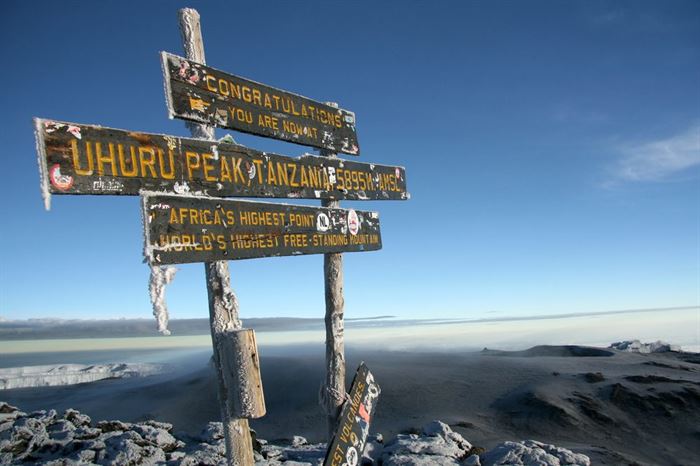
You will be woken in the midnight hours with a cup of tea and a biscuit. Dressed warmly and geared with a headlight and your daypack you will set off in the darkness. After 5 – 7 hours of ‘pole pole’, you will reach the rim of the crater, Stella Point. Another one to two hours of going slowly along the crater’s edge and you will arrive at the summit – Uhuru Peak (5895 m). Looking down over the surrounding landscape below in the early morning light, will make you feel on top of the world. You have now reached the ‘Roof of Africa’. The descent should be easy but dusty, as the volcanic ash will now have defrosted. Returning on the same route you should arrive at Barafu Camp within a few hours where the porters are waiting with food and tea. Resting for an hour or two, you will continue down to reach Mweka Camp (3080 m) for your overnight stay.

Breakfast, Lunch, Dinner
Public Campsite

Last day on the mountain. After breakfast, the crew will celebrate your achievement with a traditional song as part of their farewell ceremony. You will present them with their tips.   Setting off and descending into the moist green forest, it should take about three hours to reach the gate. Back at the Meru View Lodge in Usa River, hot showers and cold beers wait. There you can revive yourself and celebrate your achievement.

Midrange Lodge

Cost Include

  • Porterage
  • Rescue fee
  • Park fees (For non-residents)
  • All activities
  • (Unless labeled as optional)
  • All accommodation (Unless listed as upgrade)
  • A professional driver/guide
  • All transportation (Unless labeled as optional)
  • All Taxes/VAT
  • Meals (As specified in the day-by-day section)
  • Drinking water (On all days)

Cost Exclude

  • Climbing gear
  • International flights (From/to home)
  • Roundtrip airport transfer
  • Additional accommodation before and at the end of the tour
  • Tips
  • Personal items (Souvenirs, travel insurance, visa fees, etc.)Government imposed increase of taxes and/or park fees

Frequently Asked Questions

Where is Kilimanjaro?

The mountain is in Tanzania, East Africa, about 350km from the equator. The nearest towns are Moshi and Arusha.

How high is it?

Mount Kilimanjaro is the highest freestanding mountain in the world and the highest mountain in Africa. Its highest point is Uhuru Peak on the Kibo crater at 5895m above sea level.

What kind of experience do I need?

None, but previous hiking or climbing experience will help. You need to be fit and healthy and have a good pair of worn-in hiking boots. The fitter you are the more you are likely to enjoy it.

What gear do I need?

You don’t need mountain climbing gear. You can rent most of the clothing and equipment you need in Tanzania, but bringing your own clothes, well worn-in boots and a good sleeping bag is best. You will need a small day pack with enough space for wind and rain clothes, some first aid, 3 litres of water and snacks.

Warm clothes (fleece, wind and waterproof layers), good polarised sunglasses, sunscreen and a head lamp should be included in your packing list. You might prefer to use walking sticks and gaiters, but these can be rented from your trekking operator. Even thermal underwear and down jackets can be rented from us. If think you do not have the correct clothing and gear, please contact Kilimanjaro-Experience for advice.

Can I shower?

There are no bathrooms on Kili. Warm water will be supplied in a bowl and you will be able to wash your face and hands. For the rest you will use wipes. Toilets are simple, hole-in-the-ground types. Portable showers and toilets can be rented at some cost.

How long is the hike?

The shortest and toughest is the 5-day Umbwe route. Allowing extra days will help you to acclimatize better and improve your chances of reaching the summit. The easiest and most popular route is Marangu (can be done in five), but Kilimanjaro-Experience use six days for this route.

How much will it cost?

Getting to Tanzania and hiking up Kili is not cheap. But the once in a lifetime experience is worth every penny. Costs (usually quoted in USD) will depend on the tour operator and what you need. Luxuries such as portable toilets and glassware will cost more. Land costs should include transport to and from Kili, full board, porters, guides, cooks, national park fees and permits. Do not choose the cheapest operator, choose an operator who discloses all costs and who offers value for money.

Where does the water come from?

From the mountain. Porters collect water from the streams and it is boiled before use. This water will be used to fill your water canisters. You don’t need to use purification tablets, but it is recommended. Some operators offer bottled water – at extra cost as porters have to carry this up the mountain.

Do we sleep in hotels?

No. There are no hotels on the mountain and no cable cars to the top. You will most probably sleep in tents, or in basic huts if you take the Marangu route. Tents and sleeping mats are carried and set up by the porters. You do need to bring a very warm sleeping bag or rent it from Kilimanjaro-Experience.

Do we tip the hiking crew?

Yes, it is expected and much appreciated. The amount depends on the amount of days, but can range from $150 and $300 per hiker. Tips are pooled and shared amongst the crew. Bring US dollar bills.

How old should I be to make it to the top?

No person younger than 10 years is allowed according to Kilimanjaro National Park authorities’ rules. If 10 or older, they may only proceed as high as Horombo Huts (3700m) or Shira Camp (3900m) if they are accompanied by one of their parents. Kilimanjaro-Experience prefers its climbers to be 14 years and older when they attempt the summit. Climbers older than 70 years are required to show a medical certificate.

The oldest person on the mountain was Richard Byerley (84) of Washington State. He trained by climbing mountains, running and cycling. His tip? ‘Just go.’ Kilimanjaro Experience’s oldest guest was 79 years and 9 months and was from the Czech Republic.

Will I make it to the top of Uhuru peak?

A good level of fitness and a positive, determined attitude will ensure success. Also, you will need good support and the right gear.

You have a 50% chance – to make it or not. Of the 40 000 visitors Kili attracts each year, between 50 and 75% turn back before reaching the summit according a report by the International Mountaineering and Climbing Federation. The main reason for this is cold, dehydration and altitude sickness. You will increase your chances by choosing the right route, allow an extra day for acclimatising to the height, good protection against cold and good guides to help you acclimatise and pace yourself.

Request Tour

6-Day Budget Kilimanjaro Machame Route